
These figures are based on purchasing power parity of 2005.

'India is possibly the most fiscally constrained market in the region.'

The currency market won't care for our moans, groans, cries and sighs. The rupee will find its own level, explains Tamal Bandyopadhyay.
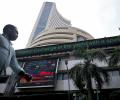
RBI policy, macro data, company earnings to decide market course this week: Experts
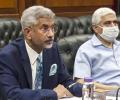
'Terrorism continues to be the overwhelming threat to security and stability in the SCO region and therefore Dr Jaishankar strongly pitched for 'collective action',' observes Dr Rajaram Panda.

Global markets trends, inflation, release of industrial output data and quarterly earnings will dictate movement of the equity benchmarks this week, analysts said, adding that volatility might continue amid slew of announcements of macroeconomic data at the global level too. Moreover, foreign fund movement, crude oil prices and trend in rupee would also act as major drivers for the equity market, they added. "The direction of global equity markets along with movement in dollar index and crude oil prices will continue to dominate while inflation numbers of the USA on May 11 and inflation and IIP numbers of India on May 12 will also cause volatility in the market," said Santosh Meena, head of research, Swastika Investmart Ltd.
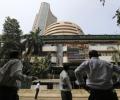
After rallying over 300 points, the 30-share BSE Sensex ended 169.14 points, or 0.42 per cent, higher at 40,581.71. Similarly, the broader NSE Nifty settled 61.65 points, or 0.52 per cent, higher at 11,971.80.

Stating that an economic recession gripped global economy following the lockdowns due to COVID-19 pandemic, Fitch Ratings on Friday said the initial disruptions to regional manufacturing supply chains in China have now broadened to include local discretionary spending and exports.

'The reform agenda is progressing in the right direction'.
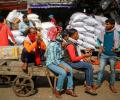
'Unemployment barely figures in the Budget except as a derived demand from the industry and infrastructure.' 'There is no effort at direct attack on unemployment.'

The concept of social security is experiencing a renaissance in developing and emerging markets.

'The Indian government wakes up after the fact when it can do nothing, or rather lacks the will to prosecute military actions to reverse these adverse PLA-driven developments.'

The FATF warned Pakistan that if it doesn't complete a full action plan by June, it could lead to consequences on its businesses

'It is certainly time for New Delhi to open up. Not only should it go ahead at full steam with the roads to the LAC, but the government must also allow tourists to visit these stunningly beautiful areas of Indian territory.'


Why is China's supreme leader promoting Han Chauvinism so aggressively, asks Claude Arpi.

The PM said there was a need to tackle the problem of terrorism in an organised manner.

Reliance Industries Ltd (RIL) was the star performer in Friday's session, spurting over 6 per cent to its all-time high, Other Sensex gainers included Bajaj Finance, PowerGrid, ICICI Bank, Maruti, Axis Bank and SBI. On the other hand, IndusInd Bank, HCL Tech, ITC, M&M HDFC and Infosys shed up to 2.94 per cent.

India has told China that disengagement at all friction points is necessary to contemplate de-escalation of troops in eastern Ladakh even as the foreign ministers of the two countries agreed to establish a hotline for "timely" communication and exchange of views.

China continues to hold out on fingering Pakistan as the 'mothership of terror,' declaring Masood Azhar a terrorist at the UN, and India's membership of the NSG, says China expert Srikanth Kondapalli.

Bharti Airtel , RCom and Tata Communications ended down between 0.1-1%.

'India imports 70 per cent of its bulk drugs from China. Are we going to live without antibiotics?' asks Debashis Basu.

'Companies with a strong business case and healthy balance-sheet should sail through and emerge more robust in the future.'

The two Indian cities were chosen among 331 applications from cities around the world for 100RC network, pioneered by the Rockefeller Foundation, New York.

The corporate sector does not care from where the money is coming.

"We are concerned about the data localisation law and the new e-commerce regulations...they do not fully take into account the needs of all stakeholders, including American and other foreign companies," acting principal deputy assistant secretary of the US, Thomas Vajda said.

Prime Minister Narendra Modi leaves for Brazil on Sunday for attending the five-nation summit of BRICS nations on July 14 and 15 which is expected to finalise the setting up of a development bank and seek reforms of the United Nations and international financial organisations.

India will have to show more willingness to import, and since Biden will not encourage sale of oil and gas to bridge the gap, it means there has to be more meaningful duty reduction in other areas even if Delhi baulks at a Free Trade Agreement so soon after walking out of RCEP.

At $2.6 trillion, the Indian economy is currently ranked sixth in the world behind the US, China, Japan, Germany and the UK.

The total market capitalisation of BSE-listed companies fell by Rs 1.36 lakh crore to Rs 93.33 lakh crore.

The government's programmes should be expected to generate some momentum, but the macro-economic numbers are not encouraging, observes T N Ninan.

Modi cautioning that cryptocurrency can spoil the youth.

'Leaders of the Indian community in Hong Kong had broached the idea of developing the Andaman and Nicobar islands for investment and setting up manufacturing units,' points out Rup Narayan Das.

'Investors should reduce cash gradually and look for value investing.'

The global recovery is expected to be asynchronous and divergent between advanced and emerging market economies, the IMF said on Tuesday, noting that policymakers should take early action and tighten selected macroprudential policy tools while avoiding a broad tightening of financial conditions. "Extraordinary policy measures have eased financial conditions and supported the economy, helping to contain financial stability risks," the International Monetary Fund (IMF) said in its Global Financial Stability report released ahead of the Spring meeting of the global lender and the World Bank. However, actions taken during the pandemic may have unintended consequences such as stretched valuations and rising financial vulnerabilities, it said.

With automation taking place at a much faster pace across industries especially in the tech space, domestic software firms that employee over 16 million are set to slash headcounts by a massive 3 million by 2022, which will help them save a whopping $100 billion mostly in salaries annually, says a report. The domestic IT sector employs around 16 million, of them around 9 million are employed in low-skilled services and BPO roles, according to Nasscom. Of these 9 million low-skilled services and BPO roles, 30 per cent or around 3 million will be lost by 2022, principally driven by the impact of robot process automation or RPA. Roughly 0.7 million roles are expected to be replaced by RPA alone and the rest due to other technological upgrades and upskilling by the domestic IT players, while it the RPA will have the worst impact in the US with a loss of almost 1 million jobs, according to a Bank of America report on Wednesday.

"The largest displacements in the context of disasters in 2021 occurred in China (6.0 million), the Philippines (5.7 million) and India (4.9 million). Most disaster displacements during the year were temporary," it said.

"Our country has never bowed down and will never bow down to any world power, and I am able to say this because of braves like you," Prime Minister Narendra Modi said on Friday while interacting with the soldiers, who were injured in the June 15 clash with the Chinese troops in eastern Ladakh's Galwan Valley.


Sectorally, bankex suffered the most by dropping 2.62 per cent, followed by finance 2.44 per cent and realty 1.63 per cent. On the other hand, telecom was among the top sectoral gainers, rising 4.60 per cent. IT index rose 2.62 per cent.
